 EN
EN  NL
NL 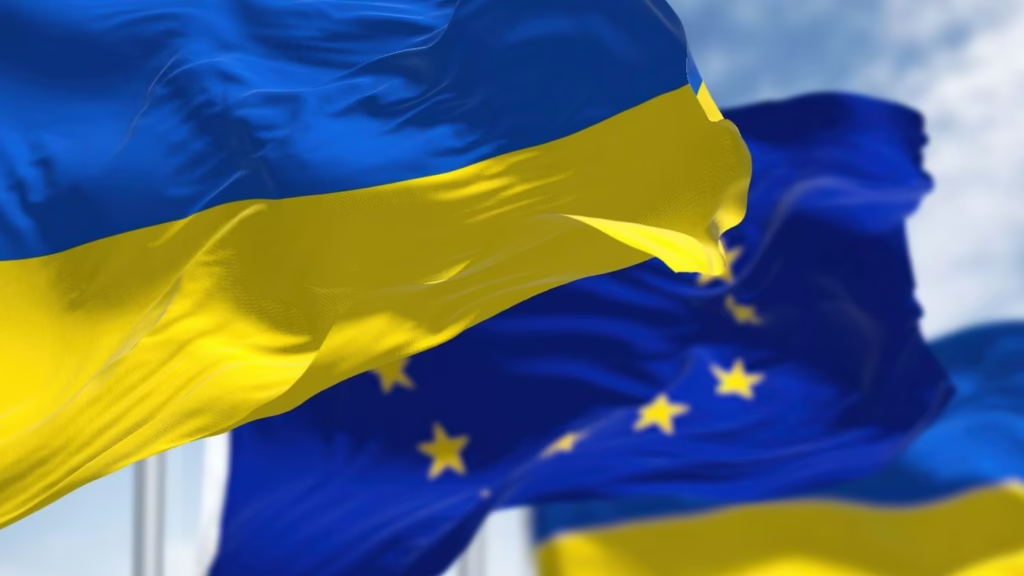
This article is also available in English.
Tomorrow, four years will have passed since Russia's invasion of Ukraine began. What began as a shock in February 2022 has turned into a protracted and exhausting reality - for Ukrainians, but also for Europeans. While European governments have consistently continued financial and military support, public solidarity with Ukraine seems increasingly fragile. Moreover, US unreliability under Trump and the growing influence of European far-right movements have changed the public debate.
While European leaders try to cope with this new reality, Ukrainians suffer daily from the worst winter of war so far, under constant Russian siege. Painting a hopeful picture of the future is becoming increasingly difficult for Ukrainian civil society organisations. How do they manage to continue their work and maintain their hope for the future? We spoke to our colleagues in Ukraine, who work every day to build a strong and resilient society in wartime.
Working through the winter
“Effective work was impossible,” says Mariia Patrul of Ukrainian Green Youth, when describing this “critical” winter: cold flats forced people to leave cities, long periods without internet. This situation affected not only the work of Ukrainian civil society, according to Bohdan Ferens (SD Platform), but also the psychological and physical state of all its participants.
Ferens“ SD Platform, which works on designing a ”peaceful post-war period“ and just and fair recovery plans for the future, finds that the current situation puts their work under enormous strain: ”I think at the beginning of the large-scale invasion it was easier to develop a vision of the future (...) now it is impossible to predict when this war will end, and under what circumstances."
And these conditions are not the only factor affecting the work of Ukrainian civil society. As Ivanna Khrapko, representative of the youth council of trade union FPU, says: working conditions and workers“ rights have always been a problem in Ukraine, even before the Russian invasion. With many Ukrainian workers staying in other European countries, she says, the challenge is to ”improve working conditions and workers' rights in Ukraine - otherwise Ukrainians will not return to rebuild their country themselves."
If there is anything positive to say, Patrul says it is that the winter “break” gave them a chance to save their strength. “As a result, we did not lose our optimism and hope,” he said.”
Change from within
According to Oleksandr Tomashchuk, representative of the Foundation Ukrainians in the Netherlands, there was indeed a decline in support for Ukraine after the first years of the war, with implications for his foundation's financial resources. According to him, reprioritisation was necessary to continue his foundation's work: to gather support, more attention is now paid to community building and cultural exchange between the Ukrainian diaspora and Dutch society.
Asked about possible explanations for this declining public support, Mariia Patrul argues that this is not purely a European problem. “The shock effect is over,” she argues. “Also within Ukraine itself, support is declining. People are tired of four years of war.” And rising inflation is making it increasingly difficult for Ukrainians themselves to support the Ukrainian armed forces.
This situation is leading Ukrainian civil society to criticise their government's efforts to maintain European solidarity. According to Patrul, the declining public support in Europe is partly due to problems within the Ukrainian elite, which publicly shows a “lack of both organisation and strategy”.
Ferens concurs: “A lot has changed since 2022, but we [Ukraine, ed.] are still using the same arguments, the same communication patterns. We need to find new arguments.”
Changing the debate
“80% of the discussion is about military support and ‘security guarantees’,” Khrapko said. “Of course that is important, our lives depend on it. But without a discussion about more workers, good working conditions and jobs in Ukraine, we cannot rebuild Ukraine itself.”
According to Ferens, there could be more emphasis from the Ukrainian side on what he calls the ‘human approach’: strengthening Ukrainian democracy, improving institutional capacity and training young people in electoral processes and democratisation. This approach could convince Europeans to maintain solidarity for “a better and fairer Ukraine” after the war.
But European politicians also have an important role to play here, Patrul says. “It is understandable that Europeans get confused when on the one hand they hear that Ukraine needs help, but then see corruption scandals in the news. European politicians should therefore consistently push for real changes within Ukraine's political and state elite.”
Ferens agrees: “We have to face our internal challenges. Yes, we definitely need to do our homework, but Europe also needs to take into account the circumstances we are in.” He says supporting Ukrainian civil society is a good way to address those challenges.
Plea for a different Europe
Changes are also needed on the European side. The current European discussion on Ukraine sometimes feels abstract to Ukrainians, Patrul stresses: “When you have an imperialist and authoritarian neighbour, there are no ‘security guarantees’. The only guarantee for peace is a strong Ukrainian army - and a place for Ukraine within the European community.”
Moreover, Khrapko argues, “it makes little sense to talk about ‘security guarantees’ as long as European countries continue to buy Russian gas and oil through back doors.” As long as the Russian war machine is partly funded by European money, she says, peace cannot be guaranteed - not for Ukraine, and therefore not for Europe.
According to Patrul, Europeans still do not sufficiently understand that Ukrainians are fighting for the freedom of the whole of Europe and thus “defend Europe itself”. It is logical, she says, that Europeans “do not feel the same fear of war”, but Ukraine is “at the heart of Europe and is a neighbour you can really cooperate with” - something she says European leaders need to explain more clearly to their societies.
Turn the argument around
In the search for ‘new arguments’, as Ferens advocates, it may help to turn the debate around, says Oleksandr Tomashchuk. “Many people in European societies understand from common sense and empathy why it is important to support Ukraine.”
In the debate about a future accession of Ukraine to the European Union, he says, one clear perspective is missing: what Ukraine has to offer the EU. “I notice a certain impression that Ukraine is weak and needs to be helped. But Ukraine - with all our experience and large army - can play a leading role in the European defence architecture after the war.”
It is not just about helping the ‘weaker’, he argues, but also what Ukraine has to contribute: extra territory, extra labour, military strength, intelligence expertise, and not least a country full of people who share the norms and values of European democracy and justice.
When Tomashchuk imagines Ukraine's future, he cannot imagine it without Europe. “But Europeans must be honest: there is no future for Europe without Ukraine.”