 EN
EN  NL
NL 
Source: Mašina/People's Dispatch
This article is the first in a series of talks in which International Foundation Groenlinks engages with green activists from different parts of the world. The series looks beyond specific moments or campaigns and instead focuses on how activists reflect on their work, their context and the current political situation. In this first episode, we speak to Andrej, a green activist from Serbia.
On January 17, the thousands of people gathered in the Serbian city of Novi Sad. This protest was initiated by university students who have been leading mass demonstrations against the endemic corruption during the rule of President Aleksander Vučić for more than a year. These students have been protesting against the president's corrupt regime for more than a year. These internal conflicts harm Serbia's prospects as an EU candidate country. Although Serbia's status as a candidate country remains unchanged, the attitude of the Serbian population is changing. A growing number of protesters are increasingly critical of the European Union. This opposition stems from the belief that European institutions are making deals with Vučić and supporting highly controversial projects, especially the lithium mining project in Jadar.
In general, there are many critical sounds hear about the EU's approach to enlargement in the Western Balkans. Critical analysts say that “while the EU talks about reforms, it encourages democratic regression by rewarding autocrats and applying conditions inconsistently”. Would a neo-idealist approach to EU enlargement policy work better in the case of the Western Balkans?
We spoke about these issues with Andrej Zlatović, a Serbian politician and activist. Andrej completed his studies in archaeology at the Faculty of Philosophy in Belgrade, after which he enrolled in cultural studies at the Faculty of Political Science. For years, he was involved in direct actions in various movements before moving into systemic change, initially with the Green Youth of Serbia. Besides his work at the Centre for Green Politics, Andrej is a co-spokesperson for the Federation of Young European Greens (FYEG).
His main areas of interest are housing, anti-militarism, radical democracy and decolonialism. Within the Centre for Green Politics, Andrej deals with the problems of the youngest and oldest in our society and the implementation of informal education.
What led you to become politically active? How did your interest arise?
“It all started in archaeology (my undergraduate). During my undergraduate studies, I started thinking about profound questions about what it means to be human, what it means to live well, and how societies throughout history have decided to organise themselves. I soon realised that the answers found in history are directly applicable to our modern world.”
He switched from theory to direct action by founding a guerrilla ecological organisation in Belgrade and volunteering at food banks. “My entry into formal politics was surprisingly simple: I met a friend for a coffee and he invited me to join his organisation. For me, participating in a movement through a group of friends is the most stable way to get involved. If you like the people and share their values, working together becomes a natural by-product of that trust.
Today, that journey led me to my position at the Center for Green Politics, where the person who sat next to me at that first cup of coffee is now my boss. I am also a co-spokesperson for the Federation of Young European Greens (FYEG). My focus has shifted to systemic change, particularly in housing, anti-militarism and radical democracy, but it still goes back to that original spark: the desire for a space where we are free to express our thoughts and decide for ourselves what our future looks like.”
Reflections on the year since Novi Sad train station collapse
Andrej describes the past year as emotional and cathartic, noting that the tragedy has turned activists“ lives upside down. He highlights a shift in the political atmosphere: Serbia has changed from a ”hybrid regime" to a state where activists are openly followed and harassed, both online and offline. He notes that the news cycle is so relentless (so much happens) that what would be a major international news story elsewhere is often pushed into the background in Serbia by new local crises.
“For me, commemorating this event with the diaspora in Brussels was one of the most emotional and cathartic moments of the year. We are now in a situation where we know that activists are being followed online and offline and people are being threatened at work. The most overwhelming feeling is that there have been weeks that felt like years because of this news cycle. You go home after a protest and look at the Instagram stories, wondering if everyone is OK, knowing that some of your friends didn't come home because they were arrested.”
The youth movement in Serbia
Andrej sees the current Serbian student movement as part of a global “Gen Z wave” also seen in countries like Nepal and Bangladesh. He notes that while different generations share a common goal, their methods and internal critiques differ.
“We want our future back. On the street, I might stand next to a monarchist or a communist, but we agree on one thing: we want the freedom to express our opinions in a democratic space. My parents” generation is more reserved and self-critical about how we organise, but they fully support the youth-led movement for democratisation. Even the veterans of the 1990s are always there, but they feel the impetus must come from the young people who will actually live the future."
How would you describe the current political landscape in Serbia?
He describes a domestic political scene paralysed by extreme fragmentation and deep existential polarisation:
“Our parliamentary opposition is equally fragmented. I think we have as many opposition parties as the Netherlands, making it impossible to form a united front. That is why the student movement has decided to be strictly non-partisan and non-NGO, to reject any ideological colour. In Serbia, an opposition activist and a pro-government person cannot even be in the same room anymore. It is no longer just an ideological divide, it is an existential divide. If we divide further, there will be no one to stand up for us or provide legal assistance when we are in jail.”
What do you think of the EU's approach to Western Balkans enlargement?
When it comes to geopolitics and international relations, Andrej argues that the Green Party in Serbia is the only party explicitly calling for sanctions against Russia and full support for Ukraine. He notes that the 300,000 Russians who have moved to Belgrade since the invasion have become spokespeople against Putin.
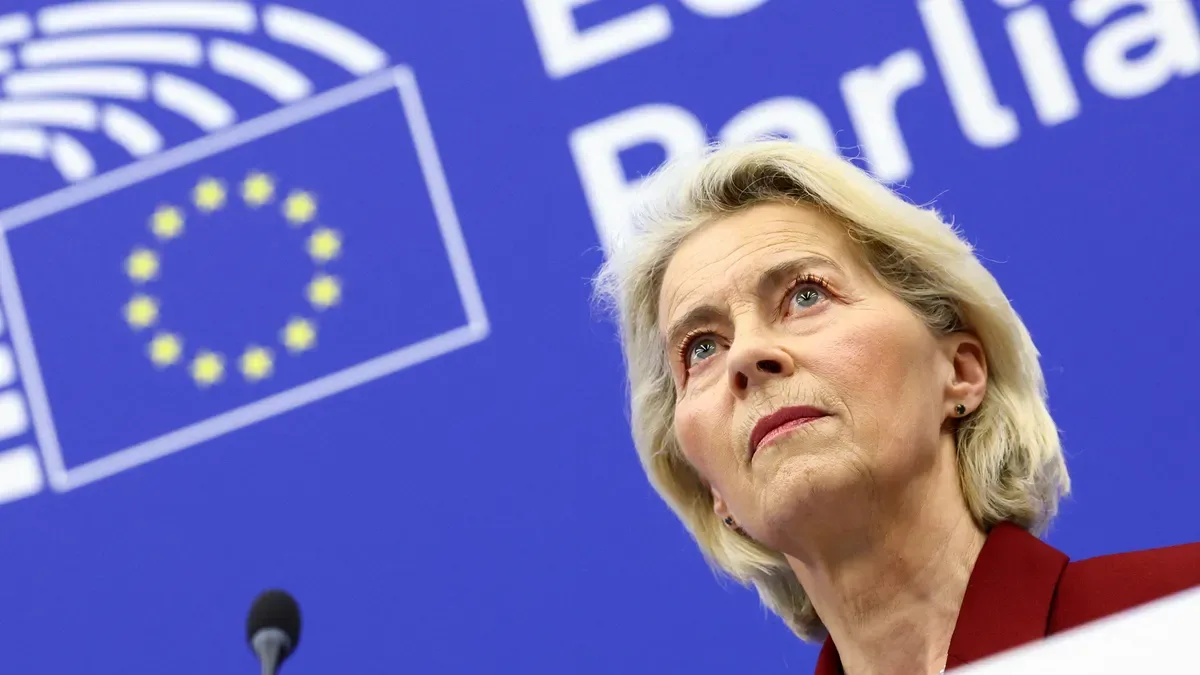
Andrej is critical of the EU, arguing that it treats Serbia as a “raw mineral supply” (lithium) or a corridor rather than a values-based partner. He criticises EU officials like Ursula von der Leyen for engaging only with the “dictator” (Vučić) and ignoring the democratic opposition.
“But I think it is very important for us to give Serbia space to break free. We just want the Serbian people to be free and to do their own thing. That is what the student movement has said: detach Serbia from Russia, from China, from the EU, from America, for a while, let it go its own way, let it figure out where it wants to go. Then when a new government is formed after ideologically free and fair elections, we can see who our partners are, because yes, many people are pro-EU, but they feel that the EU has treated us very harshly, in the sense that it has been unfair. The EU cooperated with Vučić and the Serbian Progressive Party government.
The EU has been active and has promoted its own interests. On the other hand, Russia has also promoted its own interests, but in some ways has been much better at ideological support, as it focuses on Europe's misdeeds.
A good example are the bombing by NATO in the 1990s. Russia uses this as an example and says: oh, but Europe bombed you in the 1990s. And now it is coming to tell you what to do.
Despite these shortcomings, he remains pro-EU and argues that an anti-EU stance prevents Serbia from sitting at the table where its future is decided.
“I want Ursula von der Leyen to talk to the democratic opposition and students, not just the dictator. Nevertheless, I am pro-EU because we need influence from the far-right, because if we are anti-EU, we cannot debate as equals; then the far-right will let it dictate the narrative.”
Are you familiar with the concept of ‘neo-idealism’? Does it appeal to you? What would a neo-idealist EU enlargement policy look like?
Geopolitical analyst Benjamin Tallis introduced the concept of neo-idealism in 2022 to describe an emerging, value-driven approach to European geopolitics, most clearly reflected in the statements of President Volodymyr Zelensky and several Central and Eastern European leaders. Neo-idealism stands in stark contrast to the classical geopolitical realism, which prioritises power politics and accepts spheres of influence in which major powers, such as Russia, exercise authority over smaller states.
According to Tallis, neo-idealists propagate a geopolitical vision in which security and strategic interests are explicitly embedded in a normative framework. Instead of focusing exclusively on national survival or regional stability, they put forward a broader vision of Europe as a political community that actively defends its core values, notably democracy, human rights, self-determination and the (international) rule of law. In this sense, neo-idealism does not reject geopolitics, but seeks to reconcile power and principles by viewing values as a strategic advantage rather than a burden.
Neo-idealism can therefore be understood as a morally based approach to geopolitics, grounded in the strength of values understood as ideals to strive for: human rights, fundamental freedoms and the right of citizens in those societies to a hopeful future. These are not only ethical principles, but also important sources of long-term political legitimacy and stability.
He believes the student movement embodies neo-idealist values by demanding the right to self-determination without the heavy-handed influence of superpowers such as Russia, China or the US.
While supporting this, he also acknowledges the difficulty of this approach, noting that countries like Serbia need to cooperate with non-democratic neighbours like Turkey to avoid self-isolation.
From his perspective, a neo-idealist EU enlargement policy would be a significant departure from what he describes as the current transactional approach. The EU will have to look itself in the mirror and move away from a model of “ethereal big men” (top-down leadership) and focus on a grassroots approach involving civil society and local leaders.
This also works with targeted sanctions against specific Serbian leaders like Vučić or Ana Brnabić, the president of Serbia's National Assembly, who act as “vectors” for an authoritarian regime, rather than punishing the entire population.
Lithium mining and green politics
Lithium mining in Serbia has become controversial because of its central role in the European Union's green transition and the involvement of multinational mining company Rio Tinto. With the proposed Jadar project in western Serbia, Rio Tinto wanted to extract lithium from the mineral jadarite. For the EU, domestic or nearby lithium mining is of strategic importance to reduce dependence on imports, especially from China, and to secure raw materials essential for electrification and decarbonisation under initiatives such as the Critical Raw Materials Act.
However, the project has led to major opposition within Serbia. Environmentalists, local communities and green politicians argue that mining lithium serious ecological damage would cause, including risks to water resources and farmland in a region heavily dependent on agriculture. The proposed lithium project is a major bone of contention, which Andrej views from the perspective of ecological and economic injustice.
He labels the lithium mining project a “catastrophe” and a form of colonialism. He points out a sharp contrast: the EU wants Serbian lithium for electric cars that the average Serb, who still often heats his home with wood, cannot afford. He argues for a bottom-up green transition that focuses on energy independence and participatory approaches, where companies can focus on how locals heat their homes and actually engage with farmers whose land is at stake.
Due to strong dissatisfaction and opposition from the Serbian population and environmentalists, Rio Tinto has decided this Mining project to be suspended. However, this does not mean that the EU is no longer interested in this mineral in Serbia.
What are your expectations for the future?
When asked about his dream for Serbia in 2050, he shared his vision. Andrej's vision is a free Serbia where the ruling party is separated from the state. He wants a country where officials are not blackmailed into being loyal to the party and where Serbia is an equal partner in the Balkan region.
The rest of Europe can certainly learn a lot from the youth movement in Serbia. Do you have a message for Dutch youth?
“My message to you is: organise yourselves. Find allies among your enemies and agree on a few important things. Don't tie yourselves to individual personalities. Europe must stop pretending that its version of democracy is the only norm and start learning from the ‘budding democracies’ of the South.”
So be less Eurocentric: “I am watching the presidential elections in Kenya and the situation in Madagascar with great enthusiasm. Overall, I think a lot of exciting things are happening, and Europe needs to start learning from these emerging democracies, stop pretending that European democracy is always the most valid form, and start implementing this throughout your narrative.”

Andrej Zlatović From the Federation of Young European Greens (FYEG)