 EN
EN  NL
NL 
Last week, Romania's centrist, pro-European government led by Prime Minister Ilie Bolojan fell after just 10 months. The cabinet fall caused much consternation, both within the country and across the border: Bolojan's government was pawed by a vote of no confidence passed in parliament, stemming from a partnership between the social-democratic PSD and the far-right AUR. The PSD was a partner in the Bolojan government, but withdrew from the coalition in April out of dissatisfaction with the proposed cuts - and not much later decided to seek controversial cooperation with the AUR. What explains the PSD's actions, and how are things progressing in Romania?
Unhappy marriage
According to investigative journalist Jochem van Staalduine, the Bolojan government, which took office in 2025, was an unhappy marriage from the start. The coalition, which consisted of the liberal PNL, the social-democratic PSD and the anti-corruption party USR, with some support from the Hungarian minority parties, was formed to exclude the far-right AUR. The AUR is led by young ultra-nationalist George Simion, who firmly mirrors himself to Donald Trump and Viktor Orbán, and refuses to speak out against the Russian invasion of Ukraine.
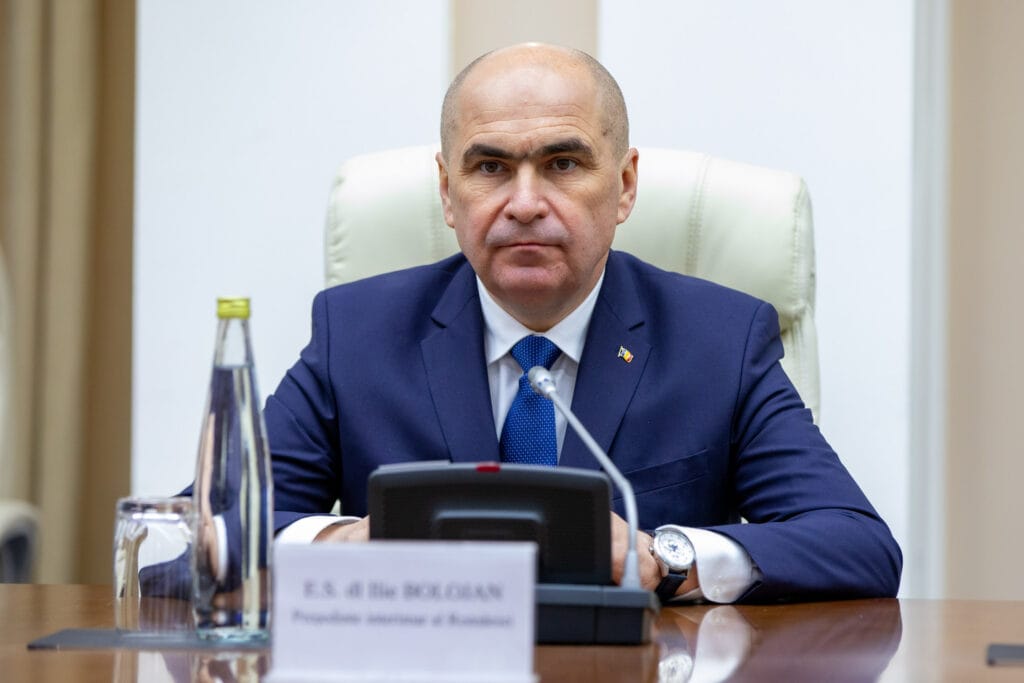
Prime Minister Ilie Bolojan of the liberal PNL
To keep Simion and his followers from power, a link between natural opposites emerged. The social-democratic PSD is a classic old power party in Romania, which has many political opponents - such as the USR, which routinely opposes the PSD - due to ongoing corruption scandals and irresponsible policies with public finances. Consequently, in the 10 months of the Bolojan cabinet, this opposition was never fully resolved. Crucially in this, Romania was still eligible for EU funds, provided it put its budget deficit in order before August this year. To thaw those billions, the PNL and USR wanted to cut public spending, while the PSD was betting on higher pensions and salaries. In the end, the PSD decided it did not want to take responsibility for an austerity policy, and quit the government.
According to Van Staalduine, this positioning of the PSD should not be seen as the behaviour of a principled leftist party, but as a populist move. The PSD in particular bears a lot of responsibility for the budget deficit Romania is now facing, partly by dodging difficult choices - especially in election years - on public sector cuts and public salaries. Partly because of this, the PSD has lost huge popularity, including to the far-right AUR, and co-responsibility for major cuts would lead to more loss of face.
Fire wall
If the PSD's move to leave the Romanian coalition for these reasons can already be considered irresponsible, the Social Democrats“ subsequent decision raises even more eyebrows: a week after the collapse of the cabinet, the PSD managed to drop the Bolojan cabinet by jointly tabling a no-confidence motion with the AUR. In Romanian media, the motion did not evoke so much surprise, says Van Staalduine: "Romania does not have such robust Brandmauer against the far-right like in Germany, and PSD people will say it was ‘just a motion’ and not intensive cooperation - as it could be in the Netherlands with a vote of no confidence.” Rather, the question is now being asked in Romania whether the cooperation between PSD and AUR could be an introduction to future government cooperation. But that chance is slim, says Van Staalduine: “The PSD is mainly open to returning to the same coalition, with new government appointments and under new leadership. The intention of this motion was mainly to shake up politics.”
While the distinction between one-off or structural cooperation may be of value in internal Romanian politics, it does not hold true at the European level. In Brussels, the PSD's actions are mostly interpreted as another example in a broader European trend, in which traditional parties in power are showing themselves to be increasingly ‘tactically flexible’ - and less and less able to set clear limits on cooperation with far-right parties. Renew-MEP Valérie Hayer, for instance, called the no-confidence motion a ‘’Irresponsible act at a critical time', and asked Romanian MEP Siegfried Mureșan for an explanation from the PES as to why it ‘links itself to one of the most radical and anti-European forces in the EU’.
That explanation did not come. Indeed, the PES declared solidarity with PSD, and made no mention of her Romanian relative's cooperation with the AUR. Instead, the European Social Democrats suggested looking forward to “new leadership” and “renewed stability” in Romania. In this way, European social democrats seem to interpret the events in Romania in the same way as the PSD itself: not as a cross-border, morally questionable cooperation between social democracy and the far right, but as an opportune coincidence on idealistic grounds that could solidify the PSD's future position in the Romanian government.
Despite the slim chance of the PSD actually entering into future cooperation with the AUR to form a coalition, this has already done the damage. The very perception that the PSD is collaborating with the far-right makes the PSD's position in Brussels vulnerable. Speaking lightly about such collaborations is naive: it ultimately weakens the position of a centre-left bloc that presents itself as the credible and principled counterforce to the rise of the radical right.