 EN
EN  NL
NL 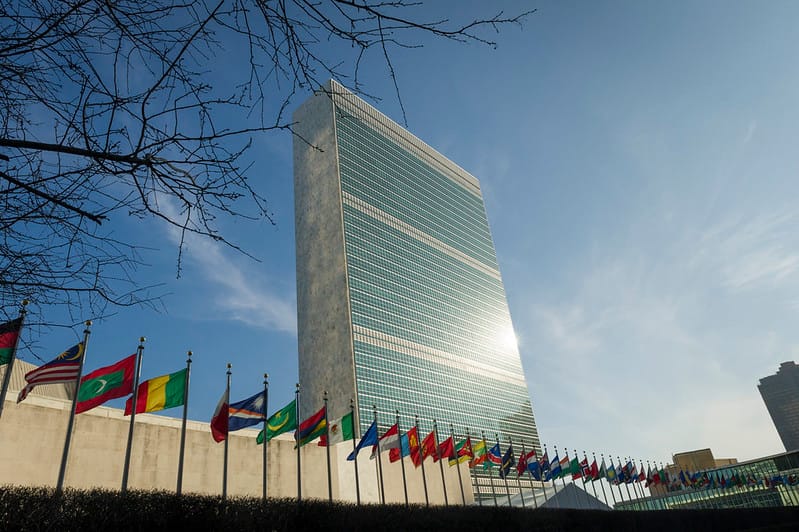
Image: Flags flying outside the United Nations headquarters in New York.
“For many Africans, achieving the UN Sustainable Development Goals is a matter of life and death. Unfortunately, their ability to meet these targets is hampered by illicit and hidden capital flows amounting to vast billions each year. […] It is high time that the international community addressed this injustice in global taxing rights, which is impoverishing millions.”
That was the message delivered by the representative of South Africa in November 2023 at the Economic and Financial Committee during the 78thste United Nations (UN) General Assembly. That General Assembly marked a turning point in the world of international tax justice. On 22 December 2023, a large majority of countries voted in favour of a resolution by the bloc of African countries to negotiate more inclusive and effective international tax agreements within the UN.
The call by the bloc of African countries for reform of the international tax system has not come out of the blue. According to Tax Justice Network Countries around the world lose 492 billion dollars annually due to international tax abuse. More than two-thirds of this is caused by tax abuse by multinational companies. As a result, governments worldwide are missing out on significant tax revenues that are crucial for funding services such as healthcare and education. This is particularly problematic for low-income countries: on average, they lose the equivalent of 36% of their healthcare budget annually to international tax avoidance, whereas in high-income countries the figure is ‘only’ 7%. Moreover, the public finances of many developing countries are already under severe strain due to growing debt burdens and the dwindling financial support from traditional donor countries. The mobilisation of tax revenue is therefore crucial to the widening funding gap for the Sustainable Development Goals to close.
Nevertheless, in 2023, a group of countries voted against the resolution put forward by the bloc of African nations. The Netherlands was one of those countries. The resolution was, however, supported by a broad coalition of countries from South America, Asia and Africa. Negotiations on the content of these new international tax agreements are now in full swing. These negotiations concern not only combating tax abuse, but also how countries allocate taxing rights amongst themselves in order to tax the profits of multinationals. Until the end of 2027, countries will be negotiating in New York and Nairobi on the text of the so-called ‘UN Framework Convention on International Tax Cooperation’. After that, it will be up to countries to sign and ratify the framework convention. This framework convention will lay the foundations for further binding agreements in the future, also known as protocols. This is similar to how the United Nations Framework Convention on Climate Change formed the basis for the Kyoto Protocol and, later, the Paris Agreement.
Although the fairness of our tax system is also the subject of heated debate here in the Netherlands, this international dimension is often overlooked. Why does the Netherlands seem to be resisting attempts to rewrite unfair tax rules? And which rules make the current international system so unfair?
An unfair system
To understand the battleground within the United Nations, we first need to take a step back. Underpinning our international tax rules is a vast network of more than 3,000 bilateral tax treaties. When a company operates in more than one country, those countries often have overlapping interests in taxing the company. Take, for example, Shell, which has its head office in the UK and production facilities in Nigeria, or Netflix, which is based in the United States but sells its digital services worldwide. From the 20e Over the course of the century, a growing number of countries therefore concluded bilateral tax treaties to share the right to tax multinationals between themselves and to prevent double taxation.
However, this allocation of taxing rights is not neutral. When negotiating bilateral tax treaties, countries generally draw on two competing model treaties: the Organisation for Economic Co-operation and Development (OECD) Model Tax Convention and the United Nations (UN) Model Tax Convention. To allocate taxing rights, such a bilateral treaty generally distinguishes between the country of residence (where the company is resident for tax purposes) and the source country (where economic activities take place and income is generated). In practice, multinationals are often based in high-income countries, whilst developing countries more frequently act as the source country. The main difference between the two model conventions is that the OECD model grants relatively more taxing rights to the country of residence, whilst the UN model recognises broader taxing rights in the source country.
Given the the ranks of the OECD That comes as no surprise. Unlike the UN, which has universal membership, the OECD represents the interests of a select group of prosperous and economically developed countries. Nevertheless, from the 1960s onwards, the OECD emerged as the global standard-setter in the field of international tax agreements. Despite the UN’s alternative model convention, developing countries have, in bilateral negotiations, not always able to stand up to the interests of capital-exporting countries. According to critics, bilateral tax treaties therefore serve primarily as a means of reducing the costs of preventing double taxation to shift from economically developed countries to developing countries.
Furthermore, the current system is inherently susceptible to tax abuse. According to Vincent Kiezebrink, one of the fundamental causes of international tax avoidance is the fact that the various subsidiaries of a multinational are all taxed separately, whilst in reality they form part of a centrally managed group: “This creates opportunities for tax arbitrage, whereby it makes sense for a company to establish itself in Bermuda and, for example, through transfer pricing ”to allow a large proportion of your profits to be channelled there.” Kiezebrink is a researcher at the Dutch research institute Stichting Onderzoek Multinationale Ondernemingen (SOMO) and investigates tax avoidance schemes used by multinationals. According to Kiezebrink, it would be better to move towards a system in which a multinational’s consolidated profit is taken as the starting point, and then to determine to which countries that profit should be allocated. “Most independent experts agree that such a system of ‘unitary taxation’It would work better than the current transfer pricing system, but ultimately it is the vested interests of countries and companies that complicate matters,” says Kiezebrink. According to him, there is still a political reluctance in the Netherlands to tackle tax avoidance effectively.
As one of the key links in the web of international tax avoidance, the Netherlands ranks 7th on the Corporate Tax Haven Index, alongside jurisdictions such as Bermuda, Singapore and the Cayman Islands. According to the Tax Justice Network, the Netherlands is therefore responsible for 12,27% of all global tax losses. This is partly because the Netherlands acts as a transit point: multinationals use letterbox companies in the Netherlands as stopovers and take advantage of our tax rules and tax treaties to channel money through the Netherlands to other tax havens. Although the government has taken a number of measures in recent years to combat the channelling of funds through the Netherlands, 90% of incoming and 70% of outgoing income flows in the Netherlands still have a throughput capacity.
Pioneers of change and guardians of the status quo
The OECD’s status as the pre-eminent authority on international tax rules is no longer as self-evident today as it once was. Critics have raised concerns about both the effectiveness and the legitimacy of the OECD’s leadership on global tax issues. In 2013, the OECD began developing new rules to combat tax competition and tax avoidance. Most non-OECD countries were only invited at a later stage to take part in discussions on the implementation of the so-called ‘Base Erosion and Profit Shifting’ rules. According to critics, the result is a deal in which developing countries come off badly once again. In 2023 concluded The UN Secretary-General also stated that existing forums are not inclusive enough and that existing international agreements do not take sufficient account of the interests of developing countries.
Against this backdrop, the bloc of African countries took the initiative to establish a more inclusive decision-making process within the UN for international tax cooperation. This is a historic move which has so far received little support from OECD countries. The Netherlands, like other EU countries, initially voted against the resolution but is actively participating in the negotiation process. Kiezebrink rejects the argument put forward by opponents that the UN process will lead to duplication of the OECD’s work: “After all, it is the failure of the OECD that has brought us to the UN.”
From the decision paper in the most recent written contribution The Netherlands“ response to the draft text of the UN framework convention shows that, in the negotiations, the Netherlands is at odds with the Global South by pushing for ”more broadly worded provisions.” For instance, under Article 5 of the framework convention, the Netherlands opposes commitments to renegotiate existing bilateral tax treaties where these do not ensure a fair allocation of taxing rights. According to the Netherlands, such obligations have no place in the framework convention and must be avoided in order to ensure a broadly supported framework convention. Although several European countries share this view, some are adopting a more constructive stance than others for the time being. Whilst commitments to renegotiate existing bilateral tax treaties are also a step too far for them, Norway and Sweden are taking a more constructive approach with their written contribution for example, it does draw on more specific wording that provides greater guidance for the drafting of future protocols.
The Netherlands is therefore not aligning itself with the leading group of countries from the Global South that are calling for fundamental reforms, but is, to put it mildly, adopting a cautious stance. This is a missed opportunity. The UN negotiations not only offer a historic opportunity to make international tax rules fairer; they also present a crucial opportunity for the Netherlands and Europe to reshape their relationship with countries in the Global South and to restore crumbling trust on the basis of genuine reciprocity.
Negotiations on the UN framework treaty are now entering a decisive phase. The final text of the treaty will be submitted to the UN General Assembly at the end of 2027. It will then be up to countries to sign and ratify the treaty. The question is which side the Netherlands will take: will it opt for a historic change of course, or for maintaining the status quo?