 EN
EN  NL
NL 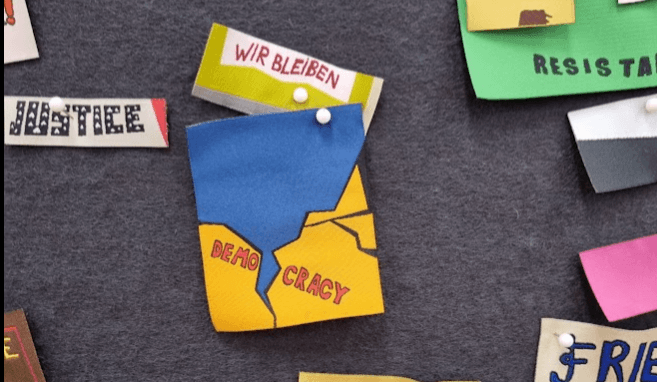
Photo taken at the Liechtenstein Art Museum.
Today we’re going to Dutch Democracy Coalition The event has been cancelled due to a Code Red alert. We were due to start right now. It’s a great pity, because the democratic climate is also in a state of Code Red. And yes, that applies to the Netherlands too. Not because things have already got as bad here as in the US or Hungary, but because we’re heading in that direction and the government still doesn’t seem to feel a sufficient sense of urgency to prevent it. That is precisely what we wanted to discuss today.
One important and topical aspect of the global democratic backsliding I would like to draw attention to. The free press and shared facts on which to base the public debate.
I should start straight away by talking about the toxic, fascist-like influence of media owners such as Elon Musk, Rupert Murdoch, Jeff Bezos, Larry Ellison and other billionaires; on the Big Tech algorithms that deceive us and pit us against one another for their own gain; or about another ingredient in the toxic cocktail threatening our free media: SLAPPs – lawsuits used by wealthy individuals and companies to get unflattering articles taken out of circulation. Take, for example, this NRC article on this subject, or this masterful exposition by John Oliver (one of my all-time favourite TV moments).
But recently, something else struck me. Advocates of free and fair media who have been made redundant, or who have even decided to call it a day themselves. Three examples:
I can’t deny that I shed a little tear during the final episode of Stephen Colbert on 21 May. It was masterful, just as I’d come to expect from him, but also bitter, because it was taken off the air thanks to a corrupt, illiberal president and media companies that care more about money than about their responsibilities in a free society.
In the Netherlands, too, it is becoming clear that journalism is no longer what it used to be and that it is difficult to continue working in the field with integrity. NRC’s brilliant political correspondent, Lamyae Aharouay, recently threw in the towel. For a long time, her interest in the substance and dynamics of politics was strong enough to help her weather the harsh headwinds that someone with her identity has to endure. But now that, in her view, the far right in the Netherlands has become completely normalised, it is impossible to continue working in that environment.
Joris Luyendijk is also stepping down as a journalist, although for other reasons, but with a severe criticism of the way the media landscape currently operates. . Among other things, he argues that the scope for critical thinking is shrinking – a standard feature of democratic decline. Journalism is no longer a profession where you can work with an open mind, but an arena where you must take sides. The polarisation has become so severe that honest, in-depth reporting is becoming more difficult – and, for many, less appealing. And, as he puts it: “Journalism really needs people who try with all their might to be neutral, knowing that it’s impossible.” And he can no longer bring himself to do that.
It seems that not only is the physical climate too hot for our meeting today, but that the media climate has also become unbearable for many media figures. If these people, who stand on the side of truth and critical thinking, no longer show up in this arena, to whom are we then at the mercy of? And what are we going to do about it?
You can already look at NGOs such as Free Press Unlimited and Bits of Freedom follow and support – you can subscribe to independent media such as Follow the Money or Investico, and there are other possibilities too. But ultimately, politicians will have to step up as well.
And that is what we would have liked to discuss today with the allies of democracy: NGOs, academics, journalists, civil servants, watchdogs, activists, political parties, and citizens, citizens and yet more citizens. We must make it clear that our freedom is a precious asset in the choices we make. Choices about where we get our information today, how we want to communicate with one another, and (!) what we demand from the platforms that serve us information. To name but a few: transparency, accountability for disinformation, and fair taxation.
Let’s make journalism a place once again where facts and integrity come first, and where brilliant journalists don’t run away, but are drawn to it.