 EN
EN  NL
NL 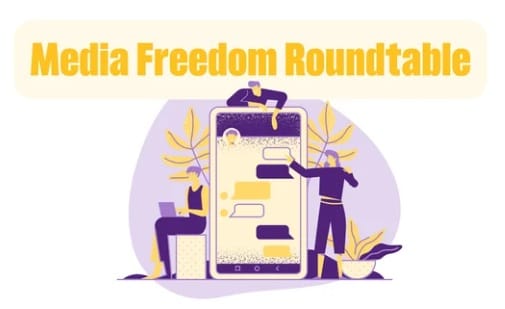
This article is a collaboration between Foundation Max van der Stoel (Martha Elias) and International Foundation Groenlinks (Yesmin Ayadhi).
According to the latest RSF index global press freedom is at a 25-year low. Even in countries that score relatively high, such as the Netherlands which ranks second, the question is how much freedom is left in practice. Censorship often happens not overtly, but in more subtle ways: legal proceedings, financial attrition, online disinformation and tech platforms that increasingly determine what we can and cannot see. In light of concerns about censorship, disinformation and tech companies' growing monopoly on information, VoltThere, the Eduardo Frei Foundation (CDA), International Foundation Groenlinks and the Max van der Stoel Foundation organised a roundtable discussion on 6 May 2026. Three days after International Press Freedom Day, we engaged journalists, policymakers and civil society activists. They talked about what puts press freedom under pressure today, but also the problem by extension: press freedom is a canary in the coal mine if we really want to protect democracy. When we talk about democratic resilience, we quickly talk about elections, institutions or foreign interference, but the way information spreads is also decisive. Who manages the flow of information influences how people look at the world, which topics get attention and which voices fade into the background. A democracy cannot function properly if citizens form their perception of reality in an environment where they are fed disinformation and propaganda. Much of that pressure today is in the way information circulates online.
Big Tech are effectively the ‘gatekeepers of the information you see’. A very apt description of how big (social) media platforms have managed to set themselves up. This is especially important for young people living online. Online, everything mixes together: journalism, opinions, propaganda and entertainment. Rarely is AI labelling properly used, and once caught in the trap, it becomes increasingly difficult to see content that does not lead you further astray. The big platforms determine what becomes visible, what gets a lot of reach and what sinks into the background. On social media, the algorithm rewards the content that most encourages engagement - liking, sharing, commenting and viewing content longer or more times. In addition, many platforms' algorithm pushes content forward more if it is uploaded more frequently. In other words, whoever says something most often, loudly and prominently is rewarded. And with that logic, polarisation often outperforms nuance.
Another valuable addition was the perspective of young people and activists, they too feel the pressure the ever-shortening attention span of the wider public. This is because of the constant flow of information - correct or false. This makes it harder to think critically about what we see, where information comes from and whether or not a source is credible.
At the same time, traditional media are increasingly being challenged. As a result, alternative online media are gaining more space and managing to reach an increasingly large audience. In principle, this is not a bad thing; traditional media companies have long had a monopoly on our access to information. The danger is not necessarily in the democratisation of information but
in the revenue model of tech companies encouraging users and creators to use less nuance in their content. That is why you more often hear information that is loud and short-sighted in nature and less content in which arguments are accurately laid out. To counter this, the EU is pushing to strengthen media literacy: the skills, knowledge and understanding that
enabling people to use media safely and effectively. This highlights an important development: more alternative voices can be heard more widely, however, the goal is that these voices also use reliable information and good arguments to make their point.
This leaves us with the question; if big tech companies play such a big role in the spread of news and information, can we still pretend that they bear no responsibility for the (mass) spread of fake news, and this lies solely with the user? The roundtable discussion sounded a clear answer to this: We should not be afraid to hold these tech companies accountable - legally, socially and financially. Sound laws and social education in this area can only be meaningful if these companies stop earning from spreading disinformation. The pressure on free media is not only coming from tech, but also legislation and legal means are increasingly being used. A clear example of this are SLAPP business, where the aim is not to undercut a journalist, but to drain away time, money and energy until working becomes almost impossible. This also raises the question of who can still afford to produce such stories, which increasingly makes journalists‘ work ’a job for the lucky few'. So this is not a battle that journalists can fight alone. Governments, civil society organisations and international partners all have a role to play here. The evening also discussed the MATRA programme, a grant programme that aims to support democratisation in countries on the edges of the European Union.
Initiatives like this roundtable, and wider collaborations between IFG, FMS, EFS and VoltThere, are also made possible with support from MATRA. When reliable journalism becomes increasingly vulnerable, it affects democracy as a whole. Especially when tech platforms have so much influence over what people get to see, and legal pressure makes reporting more difficult. Protecting press freedom is therefore not only a task for journalists themselves. It also requires something from politicians, civil society organisations and international partners. That is why IFG, FMS, VoltThere and EFS will continue to highlight this issue together in the coming period in the interests of democracy and security in Europe.