 EN
EN  NL
NL 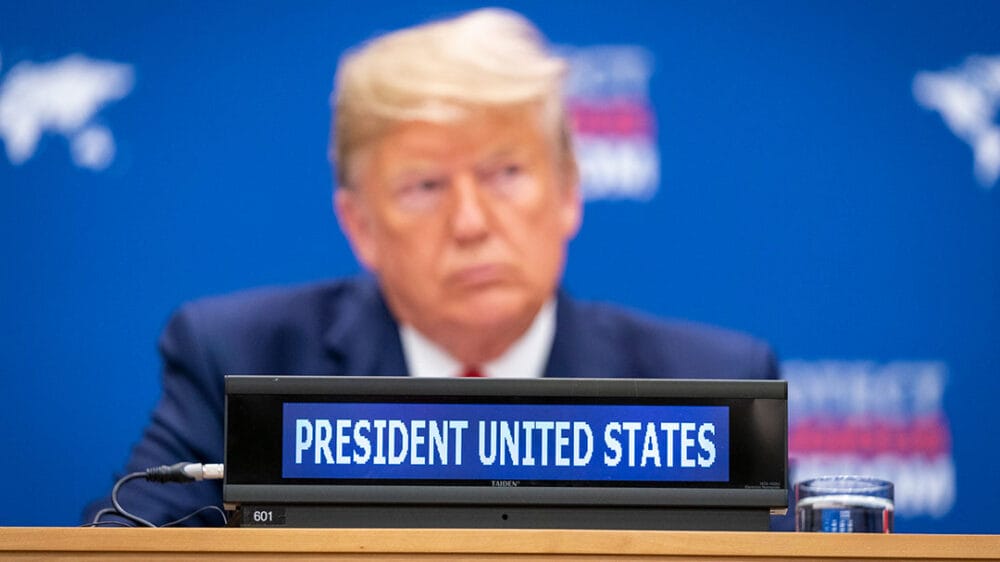
“Passing ships will be burned”. Those were the words with which the Iranian Revolutionary Guard Corps on 2 March announced that the Strait of Hormuz would be blocked. Ships that tried to cross anyway would be set on fire. US President Trump has made it clear that his allies would have to help open the Strait of Hormuz, and acting passively would “a foolish decision are”. Nevertheless, Germany, Spain and Italy to not (yet) want to undertake a mission in the Gulf region. But what Trump wants is clear: allies must help the US as well as be willing to behave according to his wishes.
However, the strategy seems to have backfired: more and more states are trying to Bilateral agreement with Iran strike and thus not surrendering at all to pressure from America. Yet the US manages to get at least the UK to agree to its Making military bases available to the US, despite Starmers' earlier pledge to be 'fixed at adhere to principles’. The problem for allies is that you with give in once to Trump not exempt from a subsequent (and possibly greater) favour. How negotiate with a president who never has enough?
The Strait of Hormuz
Why the pressure from Washington is so strong has mainly to do with the strategic importance of the Strait of Hormuz. That this strait would be closed by Iran, fell to be expected. The Strait of Hormuz borders Iran, the United Arab Emirates and Oman. The strait is of great economic importance to the whole world, because it is an important sea route for fossil fuels. In addition, the Americans have several military bases in the vicinity. These dependencies make the Strait of Hormuz a geopolitical pressure tool of considerable magnitude with which Iran can influence regional, as well as global can affect economic stability. Incidentally, there is already thought about this scenario more often and practised for it by US forces in recent decades.
In 2025, the strait was good for letting through about 20 million oil barrels per day. Oil is shipped from countries in the Persian Gulf mainly to East Asia, but anyone who has been at the pump in recent days will have noticed the price hike. Blocking passage through the Strait of Hormuz could have long-lasting effects on the global economy, but also for the course of the conflict. Iran may likewise use the Strait to collect tolls on passing ships, as a form of retaliation for the war as well as previously imposed sanctions that have severely affected the Iranian economy, and thus the Iranian people.
Endless demands
The current situation in the Strait of Hormuz is just one example of Trump's aggressive foreign policy. After the June 2025 NATO summit in The Hague, he demanded that NATO countries increase their defence spending from 2% to 5% of gross domestic product. This was already causing unrest among allies, and only Spain was an outspoken opponent of the plan. Also in the support for Ukraine is clear about the fickleness of US foreign policy: in March 2025, the US cut off all aid to Ukraine, which shortly afterwards became Resumed after negotiations in Saudi Arabia. In the process, Europe is visibly sucked into the capriciousness of US policy: it will have US weapons selling to Ukraine, provided that the allies together the bill pay. The Trump administration is rewarding cooperation not, but rather sees it as an opening for the next request.
This was reflected in the import tariffs the US wanted to impose in April 2025. These caused a lot of chaos and were framed by the US as ‘reciprocal’ levies. Although almost a year on, we know that the US president has imposed the import levies by the US Supreme Court as unfounded its assessed, levies have been reduced to 10% until July 2026. Still, the increase in levies or the intended growth in US internal trade does not seem to have been the biggest goal. The impact of the levies was immediately clear: many heads of state travelled to Washington to see if they could reach an agreement. Trump seemed only overjoyed be with these cards in his hand.
A transactional transatlantic relationship - does it break here?
The longer the US-Israel war on Iran lasts, the more resourceful states will have to become in the face of rising fuel prices. Trump is thus risking the relationship the US has with its allies. In a geopolitical climate where today's commitments are already forgotten tomorrow, it is important for allies to have a clear vision of what their new strategy should be. Ongoing agreeing to Trump's demands could lead to Europe Once again to participate in a war in the Gulf region, and this is another opening for the next request.
By the day appear we are further away from the liberal world order that is precisely the US was convenient. International law also seems more like a memory of formerly than an effective stick. It will become increasingly difficult to remain a friend of the US if allies want to stick to the values and norms that were once shared.
No clear strategy can be discerned in the current US course. This requires Europe to adapt to geopolitical realities. If we do not want to be drawn further into conflict, we need to think about new partnerships and strategies in trade, security and politics. Calling for de-escalation alone is not enough. Europe must concretely define where the line is drawn: at ground invasion, or only when energy prices escalate further? A clear and firm stance can show that Europe is willing to steer its own course. Otherwise, it risks once again going along with Washington's whims.