 NL
NL  EN
EN 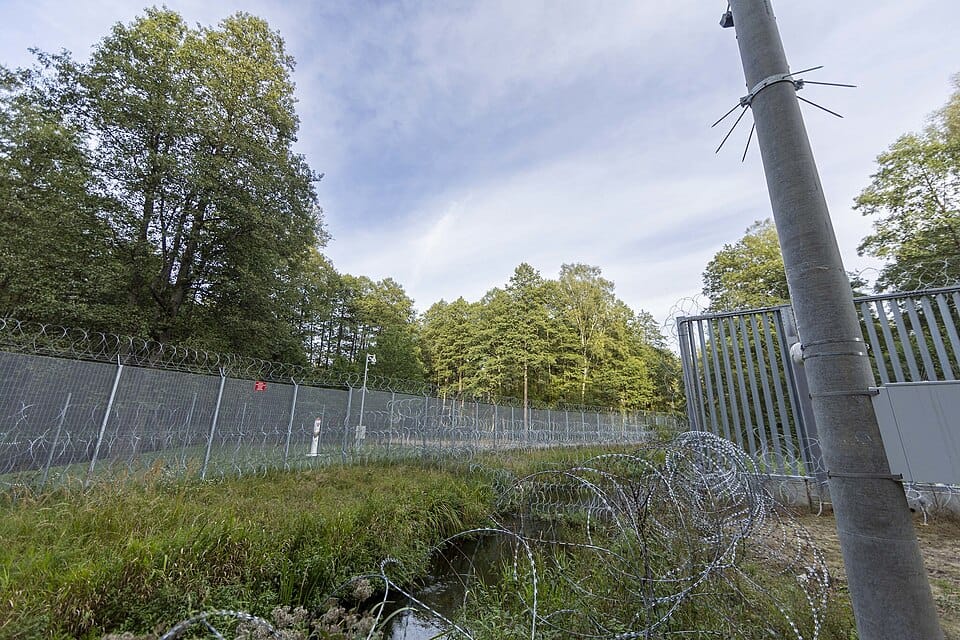
Dit artikel is een inzending vanuit een project van studenten aan de Universiteit van Maastricht. Dit artikel is in het Engels geschreven en daarom ook zo geplaatst op onze website. Foto: Lithuania-Belarus border (Wikimedia Commons).
The views outlined in this opinion piece are strictly those of the author and do not represent the official stance of Maastricht University.
When hearing the word Belarus, most people think about a proxy state that acts as an extension of Russia. What is often unconsidered, however, is that Belarus’ strategic positioning and its close alliance with the Russian Federation is especially significant in the context of European migration security. The unique geographic location of the state led by “Europe’s last dictator” enables it to shape migratory flows into the EU and act either as a partner or as a perpetrator of hybrid attacks. This ability was brought to the spotlight in June 2021, when the Lukashenka regime orchestrated a migration crisis by facilitating the arrival of migrants from the Middle East and Northern Africa to the EU’s eastern borders. Although their exact number is not known, thousands of immigrants were lured by Belarus with false promises of entry into the EU, only to then be abandoned in a border zone and forcefully pushed across the border.
What is most striking about this episode is the language used by political leaders to describe those most affected by it. Rather than being recognised as victims of Belarus’ actions and people who gravely needed the EU’s help, migrants were instead discursively characterised as a threat, as instruments of a hybrid attack perpetrated by a malevolent foreign actor. Due to this choice of discourse, the management of this immigration wave became an issue of pure security, effectively overshadowing the humanitarian aspect of immigration policies.
Most of the migrants were initially directed towards Lithuania, but after the latter passed an act enabling the pushback of all ‘irregularly’ migrating people to Belarus, Poland became the main focus of Belarusian action. Poland itself responded by declaring the border zone to be in a state of emergency, blocking aid groups, media and civil society from entering the area and making attempts to help any people stranded in the Białowieża forest a criminal offence. Despite the seriousness of these events, they remain generally unknown to the broader public, and we believe this to be highly concerning. Crises of this scale should not go unnoticed, and, as a matter of principle, involved actors ought to be held accountable for their actions.
The episode quickly degenerated into a humanitarian crisis. Both Belarusian and Polish authorities have been accused of serious abuses and of “ping-ponging” the migrants across the border. The UNHCR and the International Organisation for Migration (IOM) jointly issued a statement demanding the two states to deescalate the situation and ensure the safety and human rights of migrants and refugees. In spite of the clear humanitarian implications of the crisis, the EU has used overtly militarised language to describe the situation as a hybrid attack.
In treating migrants as tools to be used at will by third actors, a crucial perspective is lost: these individuals are not threatening weapons, but seekers of a better life and of international protection against political persecution in their home countries. By tacitly agreeing with the way migrants were treated by national authorities of its Member States, the EU seems to have partly cast aside the norms and values that it has historically championed. Although we recognise the necessity of a swift and decisive response to this politically motivated crisis, the EU’s focus should have been to provide adequate assistance to the people who suffered the most as a result of this episode: the migrants themselves. Enhancing Europe’s border security is in and of itself a necessity, but human rights should be prioritised and treated as a sine qua non of European action and legislative acts.
The number of affected migrants may have drastically decreased over the years, but public knowledge of these events and of the serious implications of the EU’s securitised discourse remain concerningly low. Furthermore, our documentary shows that multiple perspectives need to be taken into account to fully comprehend the social, political, and humanitarian significance of this crisis. We therefore strongly advocate for both raising awareness of this crisis and a more nuanced analysis of this often-misunderstood episode. Instrumentalising migrants is certainly condemnable, but so is any response that disregards not just established norms and values, but also European and international law.