 EN
EN  NL
NL 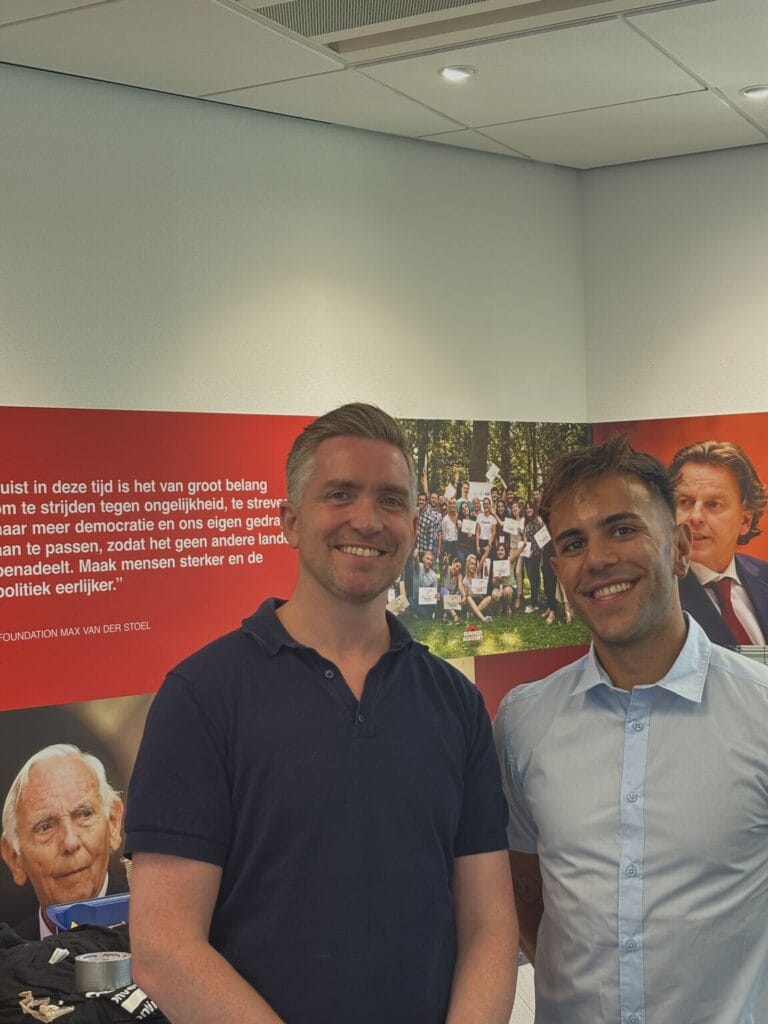
We are proud to share the winning essay by Konstantinos Chelios, written for an essay competition we organised together with the Dutch embassy in Greece. We recently had the pleasure of welcoming Konstantinos to our office. In his essay, he reflects on the legacy of Max van der Stoel and the importance of moral courage: the courage to speak out against injustice, just when silence is easier.
Read the essay below!
The Courage to Speak: Max van der Stoel's Legacy in Greece Today
By Konstantinos Chelios
Moral Courage in Everyday Life
It is a busy day in Athens. You take the metro to go to your University, listening to
your favourite song with your headphones. Suddenly, you notice people turning their
heads. A passenger is shouting at a migrant woman for no clear reason. The tension is
obvious, yet no one wants to get involved. Then one person steps forward - not
aggressively, just calmly - and says: “that's enough, please stop”. A simple act breaks
the silence that held everyone else in place. This moment captures what we call moral
courage. What makes moral courage so striking is that it «requires” from someone to
put their own safety or comfort at stake, by being fully aware that speaking up may
come with consequences (Miller, 2000).
Moments like this are not present only in everyday life. History is filled
with such instances where many remain silent while only a few choose to act. This
pattern appears again and again: the hesitation of the majority, and the rare individual
who steps forward despite the possible risks. One of the clearest examples in Greek
history comes from the years of the military dictatorship, when Max van der Stoel
was one of the very few international voices willing to speak openly against the
regime.
Between 1967 and 1974, Greece went through a period that almost broke its
democracy. Imagine waking up in Greece in the early 1970s and turning on the radio,
only to hear the same controlled broadcasts that regime allowed to reach people's
homes (Papaeti, 2013). The streets might look normal, but the atmosphere doesn't:
soldiers are standing on the corner, posters with the junta's slogans are everywhere
and people suddenly stop talking when someone they don't know walks past them.
Some testimonies even describe families whispering in their own kitchens, turning up
the radio or water tap to mask conversation because they believed that even “the walls
had ears”, a phrase that appears in several oral accounts from that period
(Georgakakis, 1992). At the same time, many European governments responded with
diplomatic restraint, maintaining formal relations with the junta despite reports of
torture, censorship and repression (Papaeti, 2013). For ordinary citizens, this external
silence made the internal fear even heavier, creating the sense that Greece was
tolerating its crisis alone (Klapsis et al., 2020).
In this kind of suffocating atmosphere, where silence dominated both inside
the country and beyond its borders, the moment a foreign voice finally chose to speak
carried an entirely different weight. As Minister of Foreign Affairs of the Netherlands,
Max van der Stoel openly condemned the human-rights violations of the Greek
military regime at a time when many European governments preferred a cautious or
neutral stance. His action played a central role in bringing the Greek case before the
Council of Europe, where he supported the investigation that exposed torture,
censorship and political persecution under the junta (Klapsis et al., 2020).
But beyond what is widely remembered, his contribution goes deeper. As
Rapporteur in the Council of Europe, van der Stoel brought to light evidence of
torture that later shaped the official condemnation of the regime (Leuprecht, 2011).
His work also laid the foundations for a historical precedent: that membership in
European institutions is not unconditional but depends on respecting democracy and
human rights, a principle that shaped the Council of Europe's approach to
authoritarian states for decades (Papaeti & Nafpliotis, 2024). As a result, historians
argue that the Greek case at the Council of Europe, in which van der Stoel was a key
figure, was the starting point where European institutions began to consider human
rights as a real political criterion and not just rhetoric (Fernández Soriano, 2017).
After the fall of the dictatorship, he became the first foreign minister to visit
Athens in 1974, and contemporary accounts describe crowds greeting him with a
gratitude that reflected how rare it was, in those years, to have someone abroad speak
for them when almost everyone else stayed silent. The significance of van der Stoel's
legacy for Greece today becomes clearer when we consider what it meant for
someone to break the silence at a time when staying silent was the easiest option.
Breaking the silence when silence is the safest path is never a simple act.
Silence protects you: from conflict, from attention, from consequences. Speaking out
exposes you - socially, professionally, and sometimes even physically. Perhaps
naturally, people tend to follow the group, especially in moments of fear or
uncertainty, because conformity may feel safer than standing alone. We may have all
felt this at some point: that strange pressure to blend in, even when something feels
wrong. This is why the person who finally speaks shifts the entire atmosphere; they
disrupt a pattern everyone else has quietly accepted. In oppressive situations, one
voice can feel like a flickering light in a dark room, a reminder that fear has not won
completely. When someone chooses to speak despite the risks, their act becomes
larger than themselves - it becomes a signal to others that courage is still possible.
To understand why Max van der Stoel's legacy matters for Greece today, we
need to look beyond the historical moment itself and recognise what his stance
represents. His intervention was not just a diplomatic gesture; it was a reminder that
democracies survive only when people - and institutions- are willing to defend them.
Greece today may no longer live under the heavy silence of a dictatorship, but it faces
different kinds of pressures: social division, political polarization, the rise of extremist
voices and challenges linked to the treatment of refugees, minorities and vulnerable
groups. He showed that safeguarding human dignity is never “someone else's
responsibility”, and that silence - even polite, institutional silence - can slowly erode
the foundations of a democratic society.
If Max van der Stoel was alive today, the battles he would face would be
different, but the moral compass guiding him would remain the same: standing with
those whose rights are easiest to ignore. He would likely open the dialogue for
refugees whose dignity if often lost in political debates, for people struggling with
mental health who are still treated with stigma instead of care, for minorities facing
hostility both online and in everyday life. He would probably try to shift Europe's
attention towards every place where silence has begun to replace responsibility - from
overcrowded camps at the borders to the quiet discrimination that happens in schools,
hospitals, workplaces.
Perhaps, this is the clearest way in which a legacy survives: not in statues or
history books, but in the choices ordinary people make when their meet their own
moments of silence. In that sense, van der Stoel is not a figure confined to the past.
On the contrary, he remains alive through us - if we choose to act with the same
courage he once showed.
As the Dutch philosopher Baruch Spinoza wrote, “the true aim of the state is
freedom”. His words echo an idea deeply rooted in Greek political thought since
antiquity: that a polis is held together not only by laws, but by the courage of the
citizens to protect freedom when it is threatened. By speaking when others chose
caution, van der Stoel acted on this shared democratic principle.
His legacy invites us to ask ourselves what it means, in our time, to speak up
when staying quiet is easier, and how the courage of one individual can encourage a
whole society to resist indifference. And so, the real question is: when the moment
comes, will we have the courage to speak?
References
Fernández Soriano, V. (2017). Facing the Greek junta: The European Community, the
Council of Europe and the rise of human-rights politics in Europe. European
Review of History, 24(3), 358-376.
https://doi.org/10.1080/13507486.2017.1282432
Georgakakis, G. (1992). Martyries [Testimonies]. Delfini.
Klapsis, A., Arvanitopoulos, C., Hatzivassiliou, E., & Pedaliu, E. G. (2020). The
Greek Junta and the International System. Routledge.
Leuprecht, P. (2011). Max van der Stoel: A tireless defender of Greek
democracy. Security and Human Rights, 22(3), 183-185.
Miller, W. I. (2002). The mystery of courage. Harvard University Press.
Papaeti, A. (2013). Music, Torture, Testimony: Reopening the Case of the Greek Junta
(1967-1974). The World of Music, 2(1), 67-89.
http://www.jstor.org/stable/24318197
Papaeti, A., & Nafpliotis, A. (2024). The 1969 ‘Greek Case’ in the Council of Europe.
A Game Changer for Human Rights.