 EN
EN  NL
NL 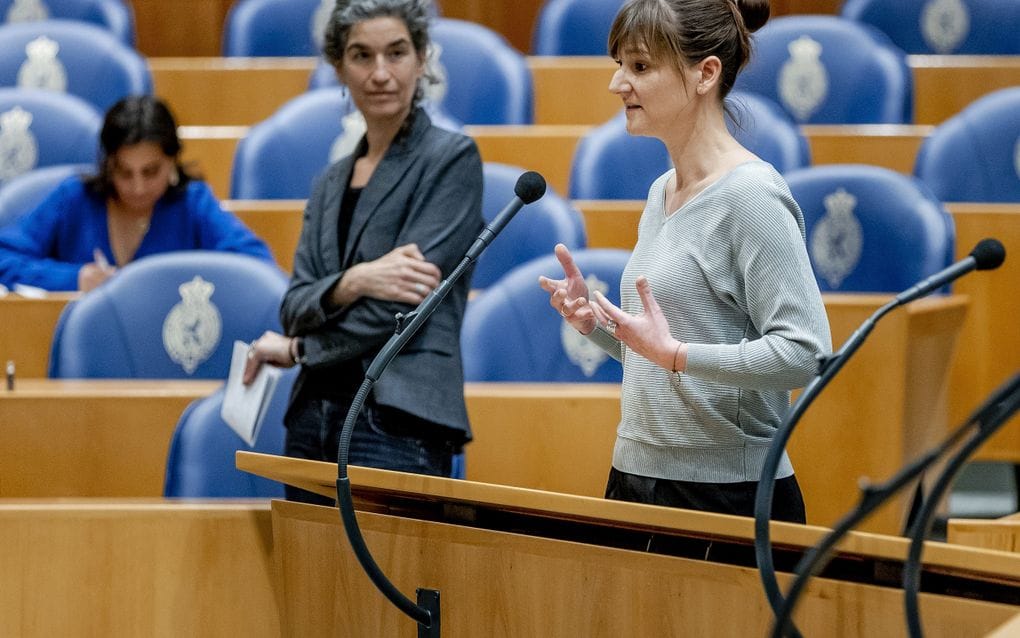
Photo: Former MP Daniëlle Hirsch (GroenLinks-PvdA) and MP Sarah Dobbe (SP) in the House of Representatives.
With the introduction of FemFocus substantially changes the character of Dutch policy on international women's rights. Dit instrument is a part of the new 2026-2030 policy and grant framework, designed to provide targeted and effective support for women's rights. In a fire letter of May 2025, made public last week, women's rights organisations warn that the new grant framework significantly limits the scope for political influence. CSOs are positioned primarily as implementers of predetermined policy goals rather than partners, while the other role of CSOs in agenda-setting, policy criticism and influencing power is largely outside the framework. This raises the question for the incoming Jetten administration to what extent structural change remains possible without explicit space for political involvement.
The breakdown of feminist foreign policy
This content delineation goes hand in hand with financial taper. The Netherlands was in the spotlight less than three years ago with the announcement of a feminist foreign policy (FBB). It stated that 85% of ODA spending gender significant should be. The core was clear: gender equality would no longer be an afterthought, but an integral premise of diplomacy and development cooperation. Realr due to the arrival of cabinet Schoof, the Netherlands halves its spending on international women's rights and gender equality from this year, and Feminist foreign policy is pontifically sidelined. Embassies will lose their delegated budgets on FBB, and Netherlands stops with funding from the UN Trust Fund to End Violence Against Women. This shifts not only the nature of interventions, but also their scale and strategic flexibility.
At the same time, the international political context in which women's rights are promoted is changing. Internationally, a well-organised anti-gender movement has become visible in recent years, focused on rolling back women's and LGBTQ+ rights. Recent research shows that these networks worldwide invest more than a billion euros annually in legislation, legal proceedings, framing and institutional power building at the expense of women's rights and democracy. Interestingly, 73% of this funding comes from Europe. This places the Netherlands among the top six donor countries. Donors include advocacy organisations and lobbyists, fundraising foundations and think tanks.
The effectiveness of these strategies can be seen in several European countries, where rights under druk have come to stand. Abortion rights have been reversed in Poland, more and more femicide for in Europe, and the druk on international institutions such as the UN, WHO and the Istanbul Convention increasing. These developments highlight that women's rights are not just a social or humanitarian issue, but are explicitly subject to broader political power dynamics.
Political sensitivity around women's rights is also increasing within the Netherlands. During a roundtable in the second chamber, international women's rights organisations pointed out that it is precisely funding for policy advocacy and advocacy that is essential to maintain social space and previous progress. Reducing this funding increases the risk of civil society organisations losing their role as political actors. Exactly that kind of funding is now disappearing from Dutch policy. At the same time, attempts have been made in the Lower House to reverse this development. For instance, MP Hirsch tabled an amendment to keep women's rights and gender equality explicitly in the budget, and a Kroger motion argued that lobbying and advocacy activities should not be excluded within the FemFocus instrument. That these initiatives had no decisive result makes it clear that without explicit political choices, women's rights are structurally losing ground.
What Femfocus leaves out of the picture
After the elimination of the FFB, Minister of BHO came up with a new programme FemFocus in autumn 2025, with the aim of promoting female entrepreneurship, countering violence against women and girls and strengthening female leadership in conflict prevention, mediation and peacebuilding. In that light, it is relevant to look at what FemFocus does not include. The tool contains hardly any preventive or structural measures and focuses mainly on mitigating existing inequalities. Policy areas that help produce gender inequality, such as trade, arms exports, tax policy, asylum, climate and security, are outside the framework. As a result, an integrated approach to gender in broader foreign policy is lacking.
FemFocus is therefore not a substitute for feminist foreign policy. It is a stand-alone grant framework, limited to civil society, with no influence on broader political choices. This leaves out other sectors. Organisations and companies can still undermine women's rights, for example by excluding women from peace processes or trade agreements, or by campaigning against sexual and reproductive health. This increases the risk of policy incoherence: while civil society organisations try to strengthen women's rights, other parts of foreign policy undermine those same rights.
A new cabinet and an old dilemma
Tomorrow, the future Jetten administration will present its coalition agreement. This creates a crucial political moment. In its election manifesto, D66 explicitly positioned women's rights as an issue that does not stand alone, but is intertwined with trade, international cooperation, climate, healthcare and education. It is precisely this integral approach that is now missing from policy. The question is whether, in the coalition agreement, women's rights are once again reduced to a niche within development cooperation, or whether the cabinet recognises that gender equality is a political criterion that should guide all foreign policy.
In a world where women's rights are increasingly explicitly at the mercy of ideological struggles, supposedly ‘politically neutral’ policies are not protection, but capitulation. While anti-gender movements are strategic, well-funded and politically organised, the Netherlands invests in apolitical service provision without counter-power.
To the new cabinet, protect women's rights not just through projects, but through political influence. Restore a feminist foreign policy in which gender is an integral criterion in trade, diplomacy, security and climate. And give civil society organisations room again not just to execute, but to agenda, criticise and function as political actors.