 EN
EN  NL
NL 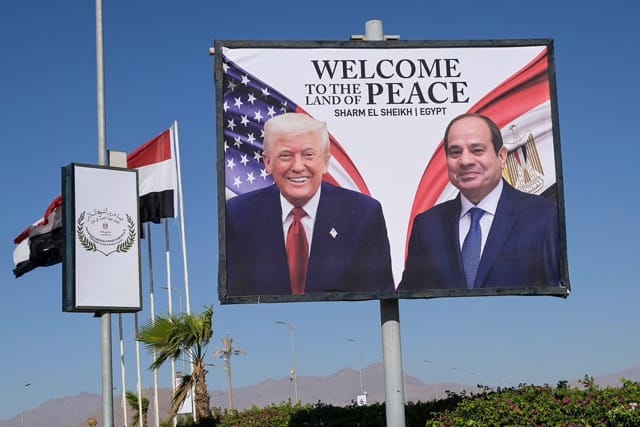
(Source: AFP)
Sisi's Egypt has recently been busy putting itself on the map as an innovative, ambitious country eager to lend a helping hand as a mediator in the region. A few months ago, for instance, the North African country grandiosely opened the Grand Egyptian Museum in Cairo. The museum stands after more than 20 years of construction of delays due to political instability finally stood up. The total cost of construction has been estimated at more than EUR 1 billion. This investment should put Egypt better on the tourism map to boost economic growth.
Egypt is also ambitiously building a new capital, the New Administrative Capital, about 50 kilometres from the current capital Cairo. Government institutions, embassies and a new business centre are largely moving to the new capital. With the total cost estimated at over EUR 53 billion. Furthermore, Egypt opened its doors to host the peace negotiations for Gaza. But with all the efforts Egypt is making to polish its image, how does it intend to profile itself on the international playing field?
Museum opens doors after decades
In November, autocrat Abdel Fattah El Sisi braced himself at the opening of the Grand Egyptian Museum among government leaders, crown princes and monarchs. The timing of the opening therefore came very conveniently, with the presence of world leaders two weeks after the Gaza peace negotiations in Sharm Al-Sheikh. The museum would exhibit the cultural heritage of Egypt's ancient civilisation with a collection of more than tens of thousands of archaeological objects. Sisi describes the opening as Egypt's pride, with a new chapter where ‘past and present come together’. Sisi also uses the museum primarily as a showpiece to stand out on the world stage of Egypt's rich history of ancient civilisation.
We spoke to a member of the Egyptian parliament, who describes the opening weekend as a flood of tens of thousands of Egyptians trying to get a ticket in the crowd. In addition to promoting Egyptian identity, the project would also economic success have to book. With high expectations, the Egyptian government is pursuing 30 million visitors annually, which should lead to a doubling of the 8% set to record 15.7 million tourists in 2024 contributed to the economy. That also comes with a price tag of over a billion, which is partly financed by loans from Japan.
The construction of the museum greatly affected local residents due to the abrupt demolition of surrounding residential flats which gave way to new paths towards the museum. With this, Sisi is trying to establish itself as a major player in the field of cultural history through this mega project.
New capital in the desert
Besides the Grand Egyptian Museum, Egypt is ambitiously building a new capital: the New Administrative Capital, 50 kilometres outside the current capital Cairo. At the spacious $53 billion costly city, however, there are several snags. For instance, the new city is virtually inaccessible to the average Egyptian. Prices for a standard flat are at $50,000, which is well above gross domestic product per capita, which is about a meagre $3000 amounts. Currently, the city is mainly staffed by officials, judges and senior officers, which makes the city look like a gated community, inaccessible to outsiders. Eventually, over 6.5 million inhabitants to be accommodated, which should take a huge burden off Cairo's shoulders, but which now remains about 300,000 inhabitants amounts.
The government's priorities therefore seem to lie elsewhere. Our interviewed MP confirms this by describing that the government is spending excessively on infrastructure to build the new city. For instance, highways are being built around the city with as many as six lanes in each direction, which is very inefficient. He argues that the government does not have the resources for this, but is carrying it out nonetheless. This while Cairo's infrastructure suffers from irregular population growth, air pollution, outdated bridges and roads.
In addition to the inaccessibility of the New Administrative Capital for the average Egyptian, it could be argued that the construction also has political reasons. For instance, Sisi is strategically removing key government buildings such as the ministries, parliament and presidential palace away from the well-known Tahrir Square. This square is known for the large demonstrations during the revolutionary Arab Spring, where crowds violently deposed Sisi's predecessor dictator Hosni Mubarak. Until today, surrounding streets were closed, putting enormous strain on central Cairo. The safe, spacious new capital should quell such revolutions and reduce the chances of an early end to Sisi's leadership.
Egypt as a land of peace
Besides the multi-million dollar projects domestically, Egypt is also opening its doors to host the Gaza peace talks. Thus, world leaders arrived two weeks before the opening of the Grand Egyptian Museum at October together in Sharm El-Sheikh to discuss follow-up steps after the Gaza ceasefire. This meeting was led by President Trump and Sisi. In addition, Egypt has come forward as a participant of Trump's peace council, in which various countries in the region, led by the US, help resolve conflicts in Gaza, among other places. In this way, Egypt aims to raise its international profile not only as one for peace negotiations, but also as a serious mediator in the region.
Egypt's stance cannot be traced only to its geopolitical location. For instance, it can be argued that autocrat Sisi is trying to divert criticism of his economic policies to international issues. Sisi's government is trying to use the Gaza war to leverage its position as a saviour of Palestinian suffering strengthen domestically and maintain popular focus on international politics rather than national.
Image versus reality
The multi-million dollar projects such as the Grand Egyptian Museum and the New Administrative Capital should put Egypt on the map as innovative and modern. Egyptian pride is present among Egyptians who want to see the long-awaited museum, as well as their country's role in ending the suffering of Palestinians. But the flaws in Egypt's infrastructure and economy are palpable in Sisi's sinking popularity. Internationally, Sisi tries to portray Egypt as a key figure and as a breeding ground for dialogue and negotiation. Nationally, he uses his multi-million dollar projects as showpieces to legitimise his power and keep pulling the strings. Also by ring-fencing his power and moving key government bodies to a ring-fenced enclave.
Sisi steps up the pressure by sweeping his autocratic traits and his failed economic policies under the carpet and diverting attention to these costly multi-million dollar projects and his role as a mediator in the region. This tactic ensures that he currently maintains his position and is regarded internationally as a ‘actor of peace’ is seen, but domestic problems are not remedied by this.