 EN
EN  NL
NL 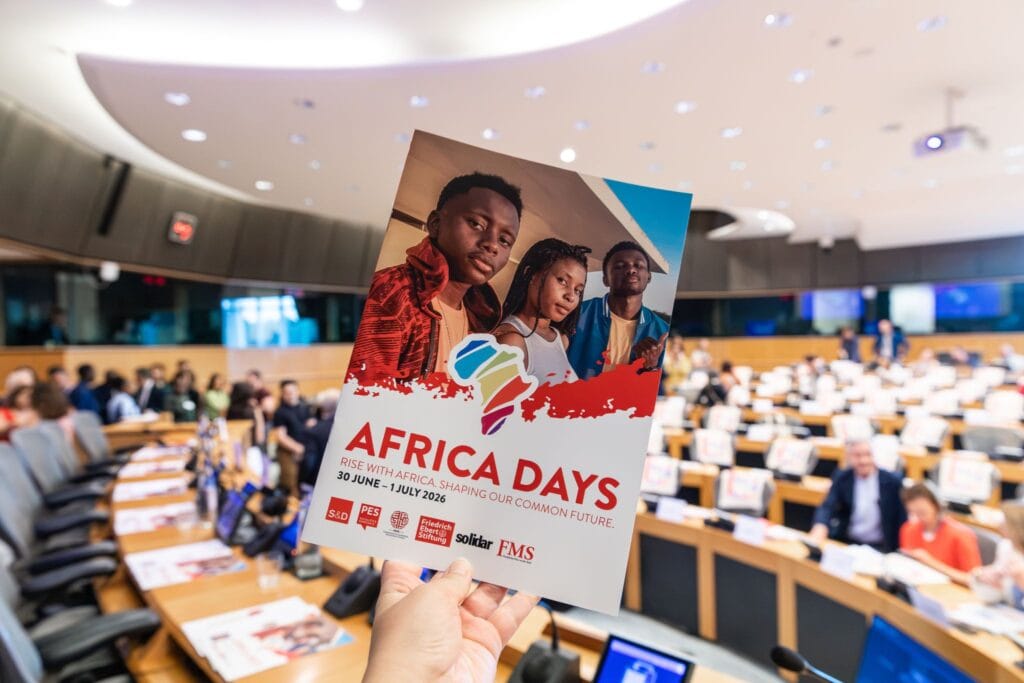
Six of our EU-Africa Youth Think Tank representatives attended the S&D Africa Days in Brussels to share their views on EU-Africa cooperation. Tarik Smaaili and Latoya Balogun wrote about their experiences in this article:
Day One: Rethinking the Africa–Europe Partnership Through the Eyes of Young People
Our Africa Days adventure actually began before we’d even reached Brussels.
Together with six Youth Representatives from the EU-Africa Think Tank and three colleagues from the Max van der Stoel Foundation, we set off for the European Parliament to attend the Africa Days, organised by the Socialists & Democrats Group. As any Dutch traveller might expect, our journey took an unexpected turn: the Dutch railways decided to keep us on our toes. Trains from Rotterdam heading south were cancelled due to disruptions, proving once again that the NS has a knack for making every journey just a little more adventurous.
Instead of letting that stop us, everyone found their own alternative route. After a morning of changing routes, delayed connections and plenty of travel updates in our group chat, we finally met up again at Breda Central Station. From there, we boarded the train together to Brussels, arriving at the European Parliament at around 10.45, which was just in time to join the opening plenary session.
The timing felt symbolic. On 30 June, exactly 65 years after the Democratic Republic of Congo gained independence, the discussions began with a strong emphasis on honest dialogue about the shared history between Africa and Europe. Rather than avoiding uncomfortable topics, this session immediately challenged participants to reflect on colonial legacies, unequal power dynamics and the future of Africa-Europe relations. One message quickly became clear: if we want a genuine partnership between the two continents, it must be built on equality, mutual respect and shared prosperity.
One thing I appreciated throughout the day was that no one tried to pretend that the relationship between Europe and Africa is simple. Instead, speakers created space for what the moderator called “meaningful friction”: honest conversations that acknowledged difficult histories whilst looking to the future. It was refreshing to hear discussions that recognised Africa’s diversity and challenged outdated narratives that often portray the continent through a single lens. As several speakers reminded us, Africa is not a single country, and its relationship with Europe cannot be reduced to a single story.
A recurring theme throughout the day was the need to move beyond traditional models of cooperation. Rather than viewing Africa primarily as a supplier of raw materials, speakers argued that value should increasingly be created on the African continent itself. Why export cocoa beans when you can export chocolate? Why ship minerals abroad when they can be processed locally? The message was clear: Africa should not export jobs; instead, it should export value.
This conversation naturally led to discussions about industrialisation, trade and the green transition. The speakers argued that a successful green transition requires flexibility, dialogue and genuine partnership, ensuring that workers are not left behind whilst both continents work towards shared climate goals.
Another session shifted the focus to economic justice. Discussions explored how wealth generated in Africa is often taxed elsewhere, whilst young people frequently face limited public services and employment opportunities at home. Rather than simply identifying these challenges, speakers proposed practical solutions, including fairer taxation systems, greater investment in local industries and the use of international trade policies to support sustainable development rather than creating new barriers.
Perhaps the most inspiring conversations centred on young people. Time and again, speakers emphasised that Africa’s greatest strength lies in its people, particularly its youth. The continent is home to the world’s youngest population, representing enormous potential for innovation, entrepreneurship and political leadership. Rather than viewing young people merely as future leaders, they were recognised as today’s partners in shaping the relationship between Africa and Europe.
As one of the youth representatives attending the conference, this message struck a deep chord with me. Throughout the day, I was reminded that our role goes beyond simply observing these discussions. We have a responsibility to ask critical questions, challenge existing assumptions and help build partnerships based on equality rather than hierarchy.
As the formal programme drew to a close, the conversations continued in a different setting during the evening’s cultural programme. Surrounded by Congolese music, African art and a festive atmosphere, it was a fitting way to round off a day that had begun with honest reflections on history and developed into inspiring discussions about the future. The cultural evening served as a reminder that partnerships are forged not only at the negotiating table, but also through the sharing of culture, stories and experiences.
Afterwards, we hopped on the tram towards our hotel in Brussels’ European Quarter. Before calling it a night, we took the opportunity to explore a little more of the city and ended up at a cosy local pizzeria, where we continued our discussions about the day’s sessions over pizza. It was the perfect moment to reflect on everything we’d heard, exchange views and get to know each other even better.
Looking back, the first day of Africa Days was about much more than policy discussions. It was about challenging assumptions, listening to different perspectives and recognising that the future of the Africa-Europe partnership will only be stronger if young people are actively involved in the conversation. Tired after an eventful day, but inspired by the discussions and new connections, we headed back to the hotel, ready for everything Day Two had in store.
Day Two: Colonial Legacies, Climate Justice and the Power of the People
The second day of Africa Days 2026 took us beyond the conference halls and out onto the streets of Brussels. From the colonial history evident in the Matonge neighbourhood to the risk of unequal green partnerships between Africa and Europe, the programme invited us to consider how the past continues to shape present-day struggles, and how young people can help build a more just future.
We started the day with a walking tour through Matonge, a neighbourhood with close links to the Congolese diaspora and Belgium’s colonial history. Walking through its streets made it clear that colonialism is not merely a distant chapter in a history book. Its traces remain visible in Brussels, even though the stories behind them are rarely discussed.
One of those stories is the one about Paul Panda Farnana, a Congolese intellectual and early Pan-Africanist. Having studied in Belgium, he used his position to challenge the injustices faced by the Congolese people under colonial rule and helped lay the foundations for Congolese nationalism. His life demonstrated that resistance was not absent during colonialism; rather, it was often deliberately overlooked.
Patrice Lumumba built on this legacy as another prominent figure in Congo’s history, exposing the violent limits of decolonisation. As Congo’s first prime minister, Lumumba became a symbol of genuine political independence and national control over the country’s future. His assassination on 17 January 1961, just months after independence, demonstrated that the formal end of colonial rule did not automatically put an end to foreign interference or to the struggles over the Congo’s political and economic sovereignty.
Both stories raised a broader question about historical memory. Colonial rule relied not only on economic exploitation and political control, but also on narratives that portrayed African societies as uncivilised, dangerous or incapable of governing themselves. Colonial propaganda celebrated Belgium’s supposed “civilising mission” whilst concealing the violence, forced labour and Congolese resistance.
Erasing history is therefore also a way of erasing resistance. When African history As it is presented as beginning with the arrival of the Europeans, generations of political thought, social organisation and opposition to colonialism disappear from view. The tour left us wondering why colonial history still receives so little attention in a country that was profoundly shaped by it.
After the walk, we continued our conversations over lunch with the other youth representatives. We talked about our backgrounds, what had brought us to Brussels, and what we hoped to achieve in the future.
Although these topics were serious, the atmosphere was warm and light-hearted. As members of Gen Z, we quickly bonded over shared cultural references, humour and similar values, despite our different backgrounds, life stories and ambitions.
The lunch gave us the chance to get to know one another beyond our formal roles. It reminded us that international cooperation begins not only with institutions and policy, but also with personal relationships, curiosity and trust.
The afternoon session focused on climate justice and the question of who benefits from the green transition. Climate change is a shared challenge, but responsibility is not shared equally: countries have contributed differently to the crisis and have very different financial and technological capacities to respond. Shared responsibility must therefore be based on the principle of common but differentiated responsibilities.
For Africa and Europe, the key question is whether the green transition will reduce existing inequalities or reproduce them in a new form. Africa is home to many of the critical minerals required for renewable-energy technologies, but processing, supply chains and profits are often concentrated elsewhere. Simply replacing fossil-fuel extraction with the extraction of green minerals would risk perpetuating the same unequal economic relationships.
Climate justice must therefore encompass trade, finance, technology and debt policy. African countries need opportunities to process resources locally, develop green industries and invest in skills and regional value chains. Europe should support technology transfer and African manufacturing, rather than viewing the continent primarily as a supplier of raw materials. Africa must therefore be treated as a co-architect of the transition.
Workers and communities should be at the heart of this process. A just transition must not only reduce emissions, but also tackle inequalities and create safe and decent jobs. This requires training, labour protections and meaningful participation by trade unions, women, young people and workers in the informal economy.
Ultimately, both continents need a change in mindset. European stakeholders must listen to local expertise and share their own without being patronising, whilst African governments must ensure that investments benefit their populations rather than a small political or economic elite.
The day ended with a screening of The People Shall, a Kenyan documentary about the youth-led protests against the 2024 Finance Bill. The film explores how young Kenyans used digital activism and grassroots mobilisation to demand accountability from their government.
It demonstrated not only the extent of public frustration, but also the determination of a generation unwilling to remain excluded from decisions that directly affect their lives.
Its message was closely linked to the issues of the day. Whether challenging colonial narratives, unequal climate partnerships or unaccountable political leadership, meaningful change begins when people recognise their own agency and insist on having a say in decisions about their future.
The screening also provided a fitting conclusion to the programme. Throughout the day, we had reflected on how power is perpetuated through institutions, economic structures and dominant historical narratives. The People Shall reminded us that these structures are not set in stone. When people organise, share knowledge and act collectively, they can challenge the terms on which decisions are made. The task ahead is therefore not only to design better policies, but also to create the political space in which communities and young people can shape them.