 EN
EN  NL
NL 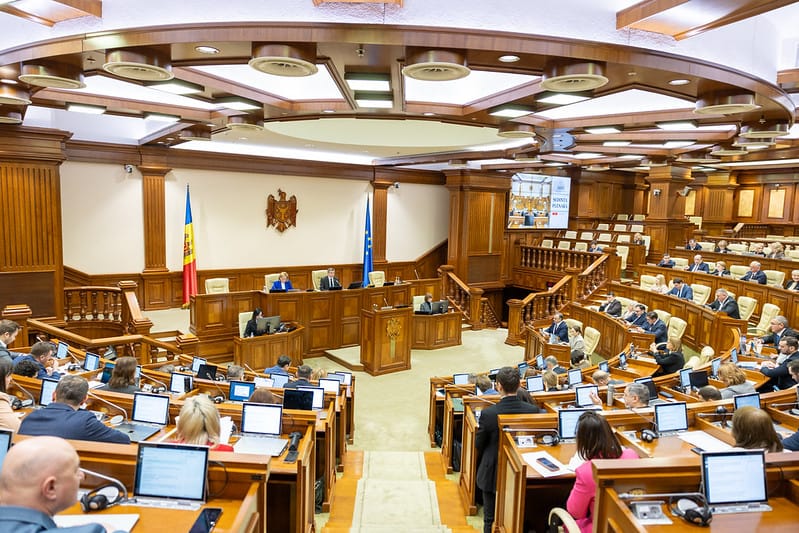
Photo: a session of the Moldovan Parliament in February 2026, source: Flickr
Amy Eaglestone recently completed her PhD in political science on democratisation in the European Union’s eastern neighbours, with a particular focus on the role of ruling parties. She combines her academic research with over 15 years’ experience in international democracy support and works as a researcher and analyst. Amy recently visited Moldova on behalf of the FMS and is currently conducting research into the situation of the opposition in the country.
In the European Union’s eastern neighbouring countries, opposition parties are often quickly dismissed as pro-Russian, anti-European and, by extension, authoritarian. In academic literature, such parties are sometimes described as anti-systemic: political movements that refuse to accept the rules of the democratic game. Given the geopolitical tensions in the region and the historical links with the socialist and communist traditions of the Soviet Union, this view is understandable. But it is also too simplistic.
At the end of May, on behalf of FMS, I met in a hall in Chişinǎu with representatives of various Moldovan opposition parties that describe themselves as centre-left or social democratic. These included both leaders of the Alternativa coalition (which has since broken up, ed.) and parties not represented in parliament. Anyone expecting a room full of Eurosceptics or secret admirers of Moscow – as they are often portrayed by the ruling party and, at times, the media – would have been disappointed. Some of those present have long political careers behind them, and several of them have, admittedly, identified with pro-Russian parties in the past. But as one civil society representative admitted: “This is the former Soviet Union; anyone who’s been around for a while has harboured pro-Russian sympathies at some point – that doesn’t mean they can’t or won’t change their minds”.
The main criticism voiced in the chamber was directed at the ruling PAS party. This is not surprising in itself; after all, opposition parties exist to scrutinise the government. This group, for example, argues, amongst other things, that PAS pays insufficient attention to the poor socio-economic situation of many Moldovans. But behind the political rhetoric lay a genuine concern about the way in which European integration is being shaped by both the ruling party and the EU. They argued, for example, that European representatives do not sufficiently highlight in public the democratic shortcomings of the current ruling party, such as the limited involvement of the opposition in key reforms, the polarised political climate and the concentration of political power. Despite the diverse group of ‘social democrats’ present, there was a striking degree of agreement on this point: PAS is making mistakes, these mistakes are not being sufficiently highlighted by the EU, and this is not in Moldova’s best interests.
These critics of the government are often lumped together with the oligarchic and genuinely anti-democratic movements centred on Ilan Șor, or the socialist party PSRM, which maintains strong ties with Russia. This blurs the distinction between legitimate opposition and parties that actually undermine the democratic legal order.
Many of the politicians present were not so much pro-Russian as critical of the government and the European Union. Their criticism was not directed at European integration per se, but at the way in which Brussels appears to identify strongly with a single governing party, and the way in which that governing party excludes others on the basis of its ties with the EU. In their view, this risks turning European integration into a party-political project, rather than a national ambition supported by multiple political movements. This should be a cause for concern in Europe. When only one party is seen as a credible European partner, the European agenda becomes vulnerable to electoral fluctuations. For if the current momentum for European integration in countries such as Moldova were to wane, and the current ruling parties were to be held to account for this, genuinely anti-democratic parties would be standing by, ready to steer these countries onto an anti-European course. Are opposition parties in Moldova and other Eastern European countries really as pro-Russian as is often assumed? To some extent, yes, but we must distinguish between anti-system parties that reject the rules of democracy and democratic opposition parties that critically scrutinise the government. Otherwise, you fail to recognise the political diversity within the opposition and narrow the scope for crucial democratic debates. At the same time, it is up to that same critical opposition to continue demonstrating its commitment to democracy. It is up to international observers to share their insights and identify the nuances so that we can achieve a broadly supported and shared European future with current candidate countries such as Moldova.